Winter navigation policy
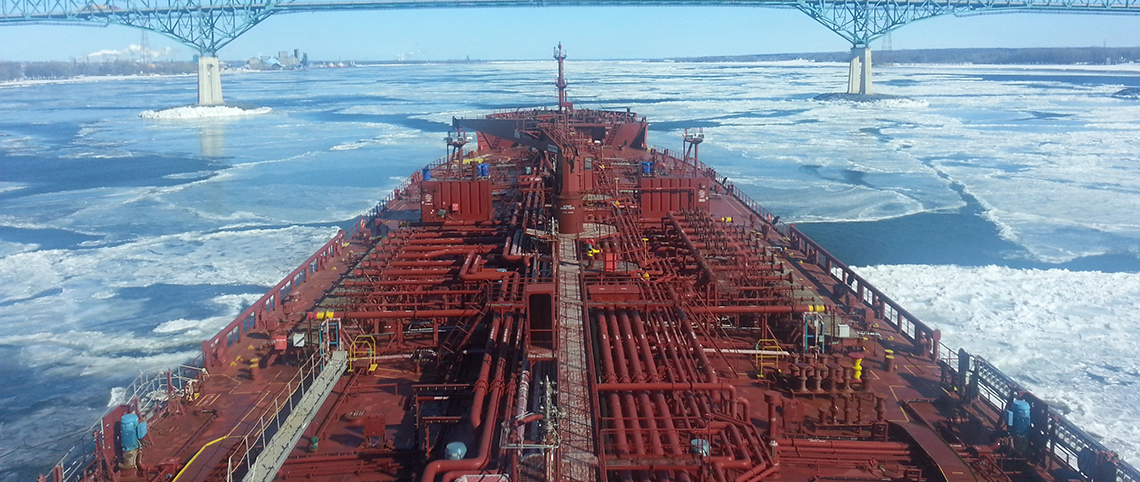
Since the St. Lawrence River is freshwater for much of its length, it freezes every winter, at which time specialized equipment is required and specific safety regulations come into effect.
In preparation for the winter freeze, the Canadian Coast Guard removes lighted “summer” buoys and replaces them with spar buoys, which may not be lighted but perform better in the winter. The schedule for removing buoys is published as part of the Aids to Navigation program and is also available on the Marinfo website (www.marinfo.gc.ca).
Given the narrowness of the channel and the limited under-keel clearance between Montréal and Québec City, removing or replacing priority lighted buoys has a major impact on night navigation in this zone. As soon as these operations begin, navigational restrictions apply to the departure of certain ships travelling either downstream or upstream in the affected sectors. Either one or two pilots are assigned responsibility for navigation depending on the type of ship and time of sailing. At this point, however, winter navigation conditions are not yet officially in effect.
For the zone between Québec City and Les Escoumins, including the Saguenay River, the double pilotage period begins when ice forms between Québec City and Cap Brulé, with the actual start of the period announced following consultation between the Corporation des pilotes du Bas Saint‑Laurent and the Laurentian Pilotage Authority.
The start of winter navigation is determined by the Laurentian Pilotage Authority in consultation with the appropriate authorities, our pilots and the maritime industry, as stipulated in section 35(2) of the Regulation. The decision is based, in part, on an analysis of the following factors: air and water temperature, condition of navigational aids, and water level.
As soon as the start of winter navigation has been announced, every ship must have two pilots on board. Given that winter navigation conditions are more difficult, the pilots work collaboratively on the bridge. The winter navigation period remains in effect until temperature and ice conditions return to a satisfactory level and summer navigational aids have been reinstalled.
During the winter navigation period, the Canadian Coast Guard produces ice maps and provides ships in need with escorts and assistance. Ships visiting our waters should nonetheless have appropriate navigation equipment in good operating condition in order to minimize the restrictions imposed on them. This equipment includes 10-cm and 3-cm radar, both with gyro interface, a heating system on the bridge, and an AIS connection for the pilots’ sophisticated PPU device—a high-tech navigational aid provided to all pilots.
When all priority lighted buoys in a given zone have been reinstalled, departure and transit restrictions are lifted for that zone. Here again, the spring mooring schedule is set by the Canadian Coast Guard and announced to the maritime industry and other stakeholders.
Every year, the Laurentian Pilotage Authority publishes departure and transit rules on its website. These rules are reviewed every spring with the Corporation des pilotes du Saint‑Laurent Central and Corporation des pilotes du Bas Saint-Laurent to determine whether navigation can be made more efficient without compromising safety.